
How we check an arm guard before listing it
Four things decide whether an arm guard does its job: a plate that stays where you set it, straps that follow a tapering forearm, ventilation for a full session, and a material declared plainly. Here is how the Fletchguard guard answers each one.
1. A plate that stays where you set it
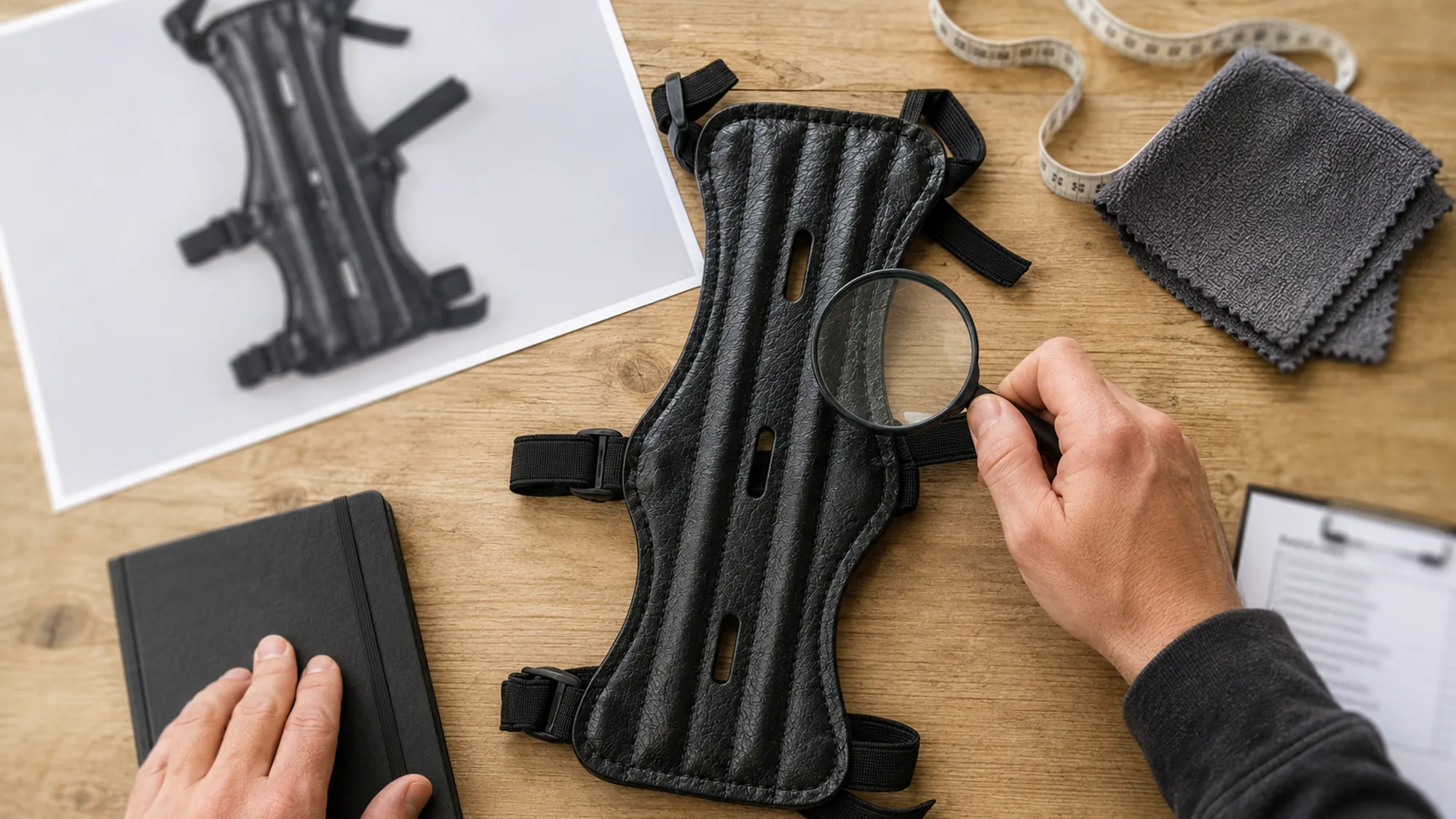
Two-strap guards pivot around their own center when the string hits them, and creep toward the wrist over a session. The Fletchguard plate is held by three straps: the one in the middle removes that pivot. The plate has an hourglass waist, so it wraps the forearm rather than bridging across it, and it sits low enough that it does not become a fresh obstacle for the string to catch on.
2. Straps that follow a tapering forearm
A forearm is not a cylinder. Each of the three elastic straps adjusts on its own sliding buckle, so the elbow strap can run looser than the wrist strap. Set the middle strap first and snug, then the wrist strap, then the elbow strap last and loosest. The guard is one size; if either measurement of your forearm is above roughly 13 inches, a longer sleeve-style guard will suit you better, and the size guide gives you the two-minute method to check.
3. Ventilation for a full session
A solid plate against skin in August becomes unpleasant quickly, and an archer who has taken the guard off is an archer who is about to get hit. Three long slots run down the face of the Fletchguard plate, so sweat evaporates through the guard rather than pooling underneath it.
4. A material declared plainly
The face is PU leather, also called synthetic leather, over a light backing, stitched around the full perimeter with a bound edge. It has the grain and the look of leather and wipes clean with a damp cloth. It is not animal hide.
5. Delivery as promised
Orders are dispatched in 1 to 2 business days and delivered in 6 to 10 business days in total, free to 4 countries, with a 30-day money-back guarantee.
What buyers report
The guard is rated 4.7 from 125 verified ratings. 41 of those buyers wrote a review, averaging 4.68 out of 5, and none of them describes the guard failing in use: no torn strap, no broken buckle, no split plate. Two found it smaller than they expected, so measure first with the size guide. What each review talks about is broken down on the product page. If yours ever fails, tell us on the contact page.