
An archery arm guard that keeps the string off your forearm
Three adjustable straps, vented PU leather, one size that fits most adult forearms. Built for the shots you take before your form is perfect.
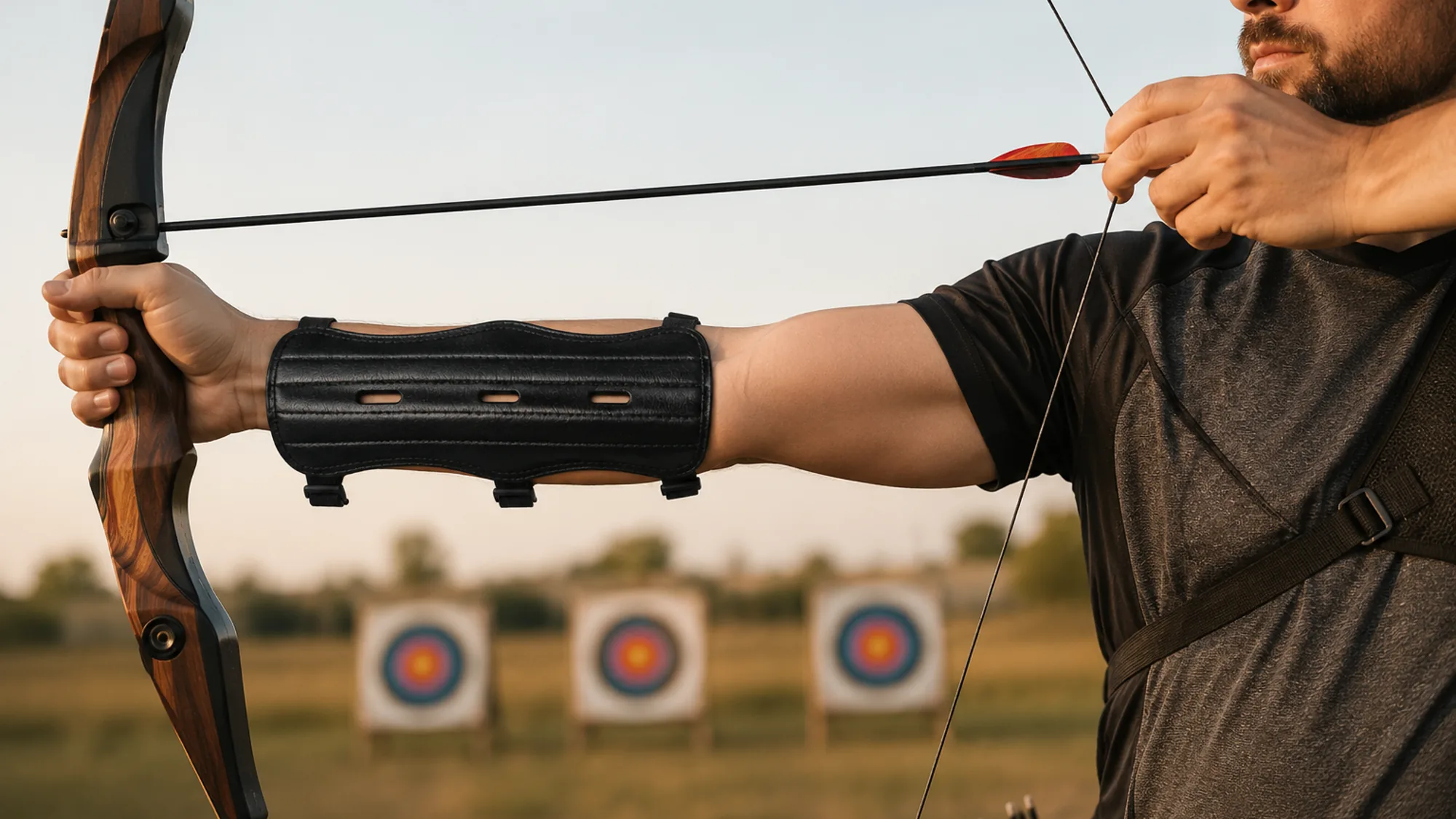
String slap is a form problem you fix slowly and a pain problem you fix today
Anyone who has been hit once knows the sequence. The string catches the soft inside of the forearm, there is a sharp line of heat, and by the next morning a purple stripe has appeared that turns yellow at the edges over the following week. The physical injury is minor. What it does to your shooting is not.
Once your body knows the string can hurt, it starts protecting you without asking permission. You drop the bow arm a fraction early. You pull the elbow in. You release before the sight has settled because part of you wants the shot over with. Every one of those is a flinch, and a flinch is invisible from the inside. Archers spend whole sessions wondering why their groups opened up when the answer is that they stopped committing to the shot after the second hit.
A guard breaks that loop. Not by improving your technique, it does nothing for your technique, but by removing the consequence long enough that you can work on form calmly. Coaches put a guard on a beginner in the first ten minutes for exactly this reason, and plenty of archers with twenty years behind them still wear one, because a cold morning and a thick jacket sleeve will catch a string no matter how clean your release is.
There is a second reason, discussed far less often. A string that hits your arm loses energy and gets deflected, which pushes the arrow sideways depending on your handedness. So the bruise is not only painful, it is also costing you the shot on which it happens.
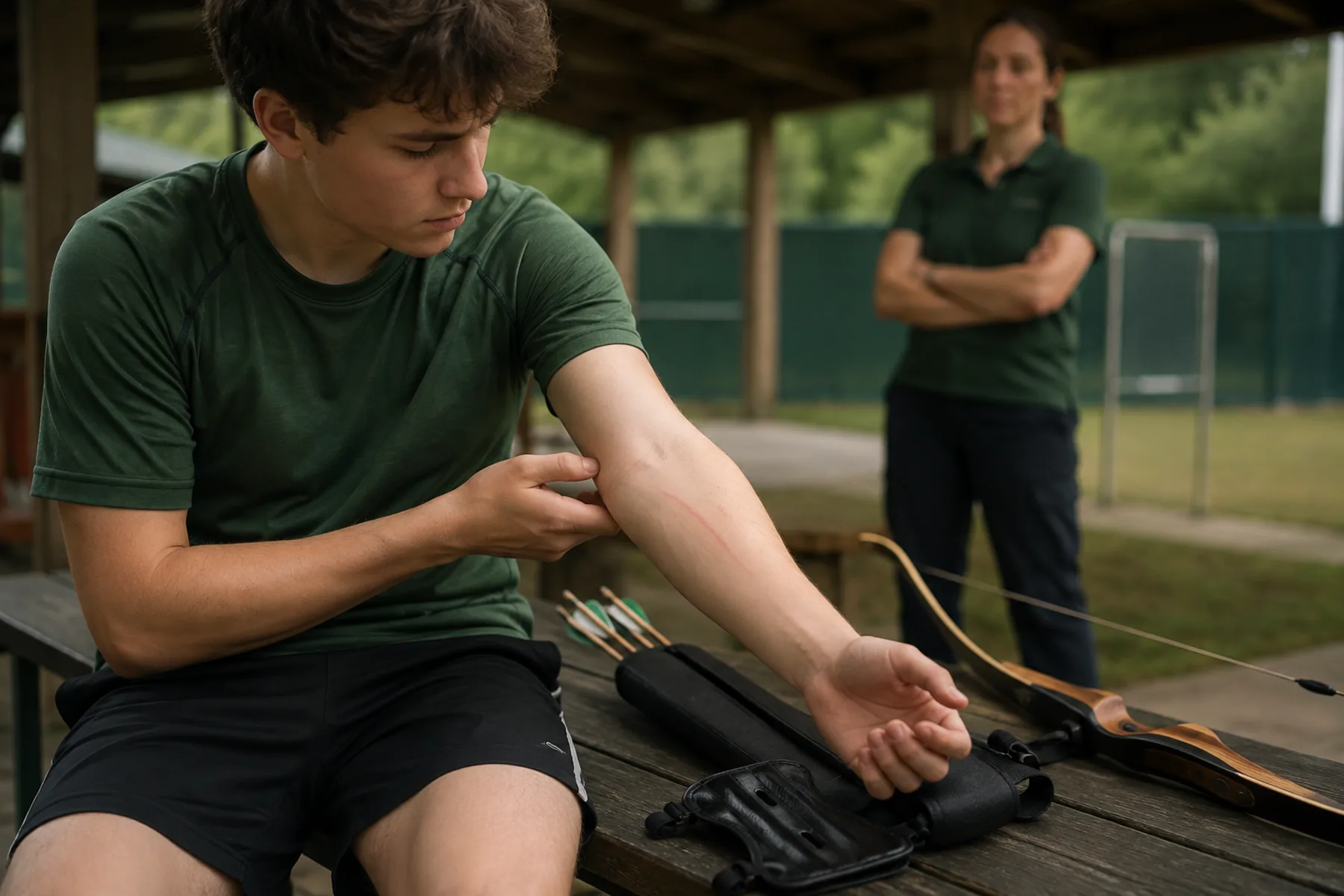
Three details that decide whether a guard stays put
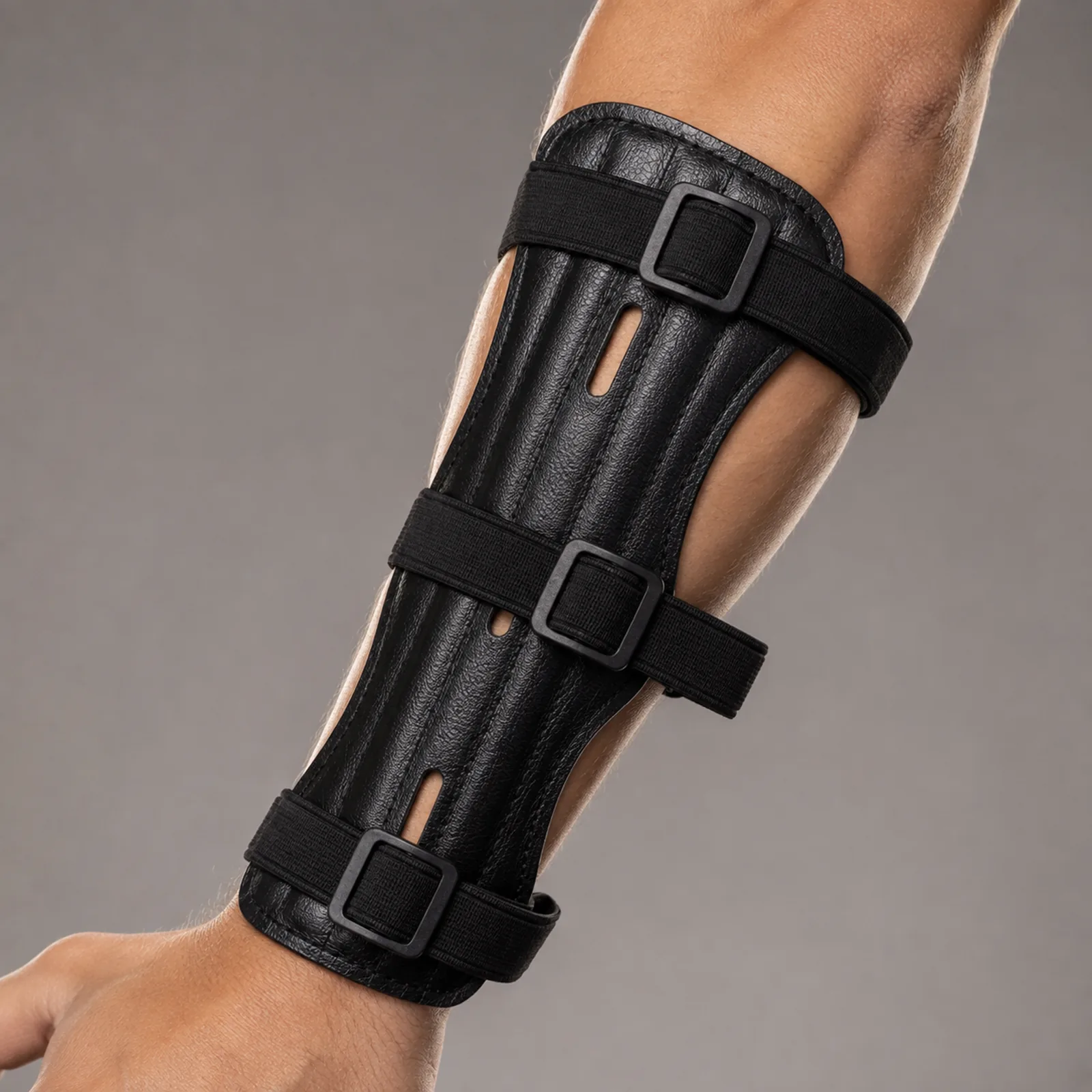
Three straps instead of two
Two-strap guards pivot around their own center when the string hits them. A third strap in the middle removes that pivot, so the plate stays where you set it instead of rotating toward your wrist over a session.
Each strap adjusts on its own sliding buckle, which matters more than it sounds. A forearm is not a cylinder, it tapers. Running the elbow strap looser than the wrist strap is what stops the guard from either sliding down or pinching at the narrow end.
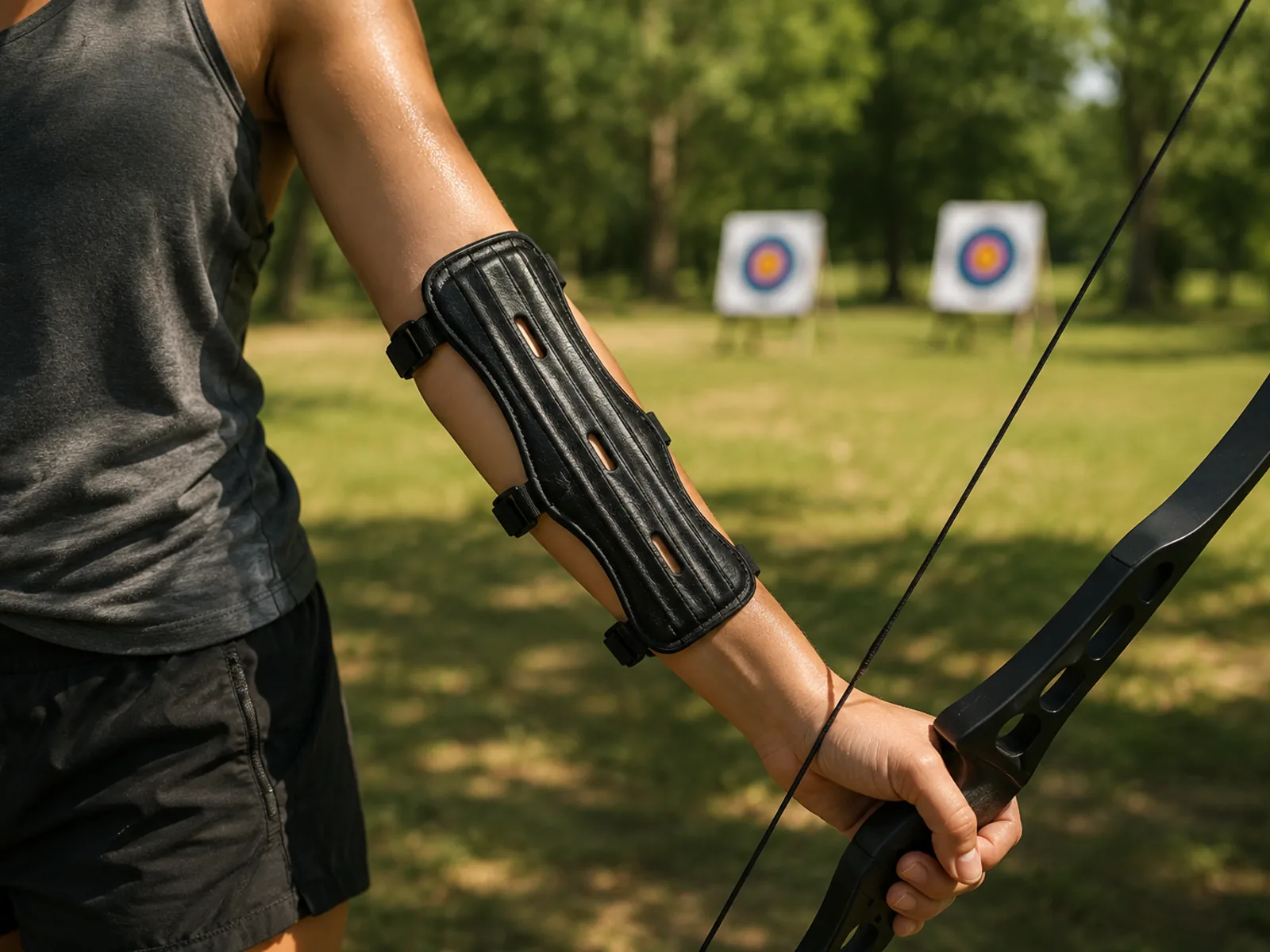
Vent slots down the face
Three long slots run down the plate. They let sweat evaporate through the guard rather than pooling underneath it, which is the difference between wearing it for a full session and taking it off after twenty minutes.
A solid plate against skin in August becomes unpleasant quickly, and an archer who has taken the guard off is an archer who is about to get hit. The slots also shave weight off a piece of kit you want to forget you are wearing.
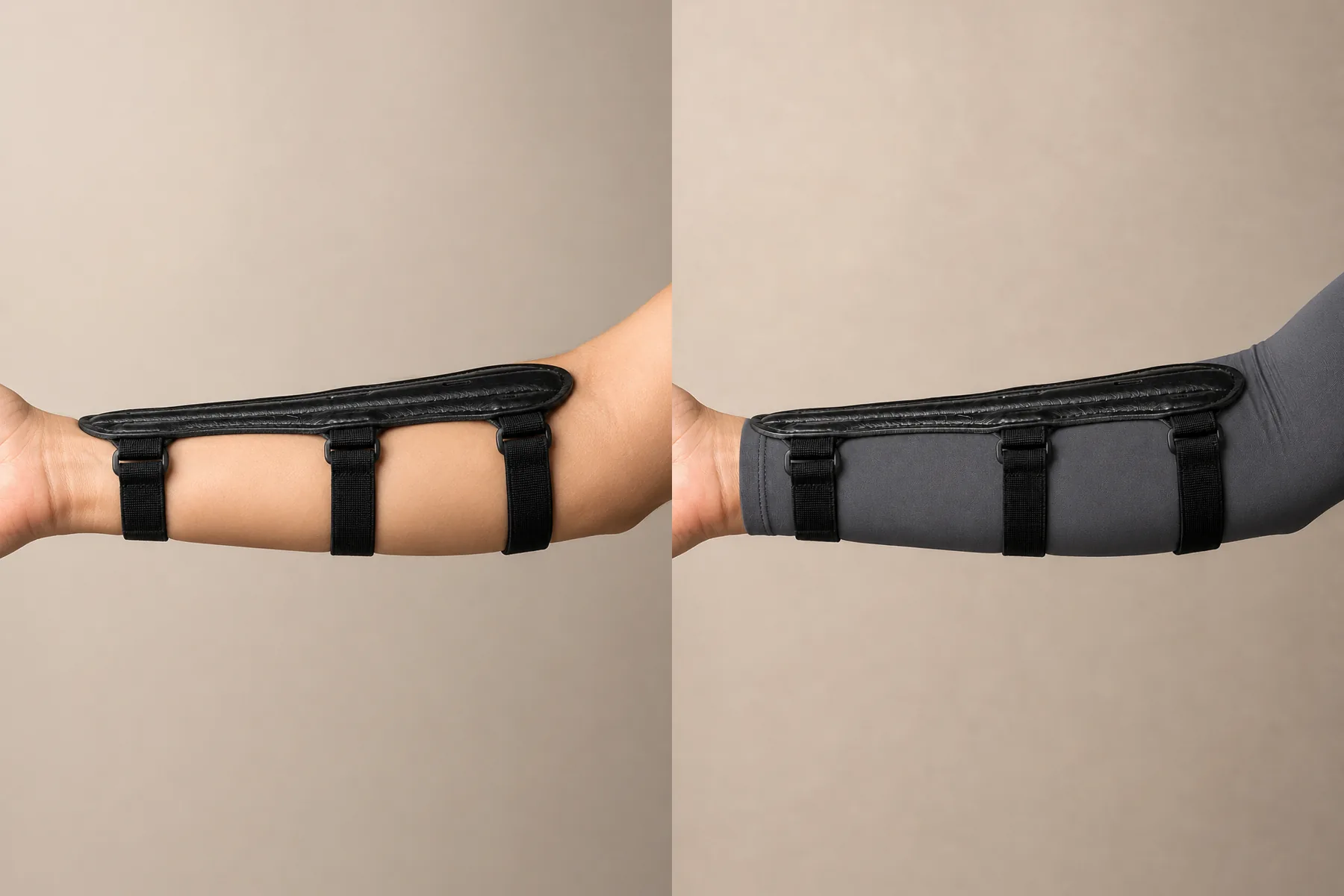
A low, curved profile
The plate has an hourglass waist so it wraps the forearm rather than bridging across it. A guard that stands proud of the arm becomes a fresh obstacle for the string to catch on.
The face is PU leather over a light backing, stitched around the full perimeter with a bound edge. That binding is what stops the layers separating at the corners, which is where cheap guards fail first.
What the 41 written reviews talk about
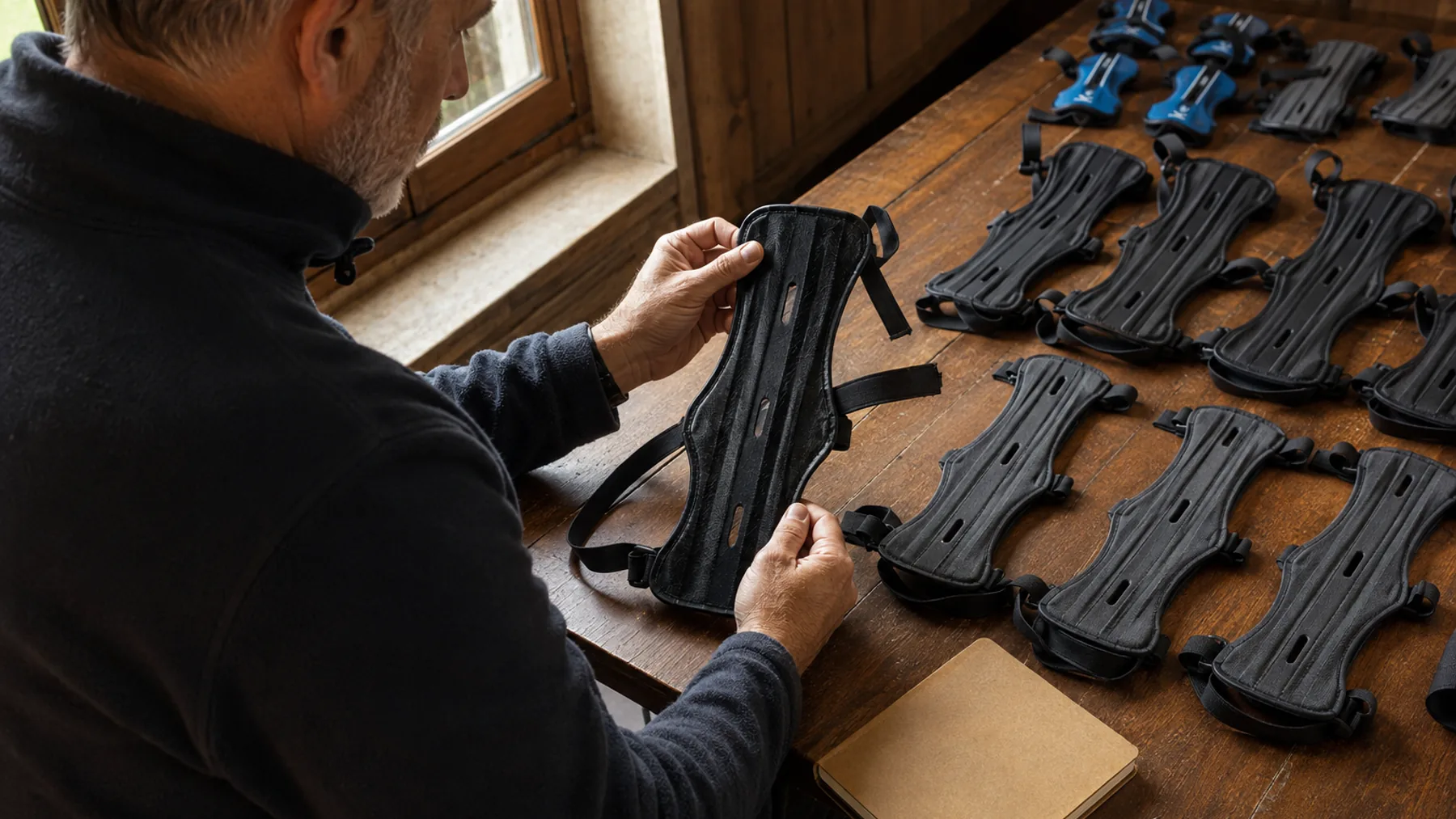
The guard is rated on 125 scores, and 41 of those buyers also wrote a review. Here is what they talk about.
| What buyers mention | Times | What it means in practice |
|---|---|---|
| Matches the description | 8 | The most repeated point across the corpus. |
| Worth the money | 6 | Almost always phrased as a price comparison. |
| Good build quality | 5 | Stitching and edge binding get named specifically. |
| Good material | 4 | Buyers describe the surface as leather-like, not leather. |
| Fast delivery | 4 | Several report arrival ahead of the estimate. |
| Fiddly at first | 3 | The straps take one session to set. See the fit guide below. |
| Smaller than expected | 2 | Both were three-star reviews. Measure your forearm first. |
Average of the 41 written reviews: 4.68 out of 5, from 32 five-star, 5 four-star and 4 three-star ratings.
Two things stand out. None of the reviews reports the guard failing in use: no torn strap, no broken buckle, no plate splitting. Every complaint is about the first fitting session or about expectations of size, and two buyers found it smaller than they had pictured; both left three stars. Read the fit guide below before you order and you will know which group you belong to.
Why forearm protection counts as standard kit
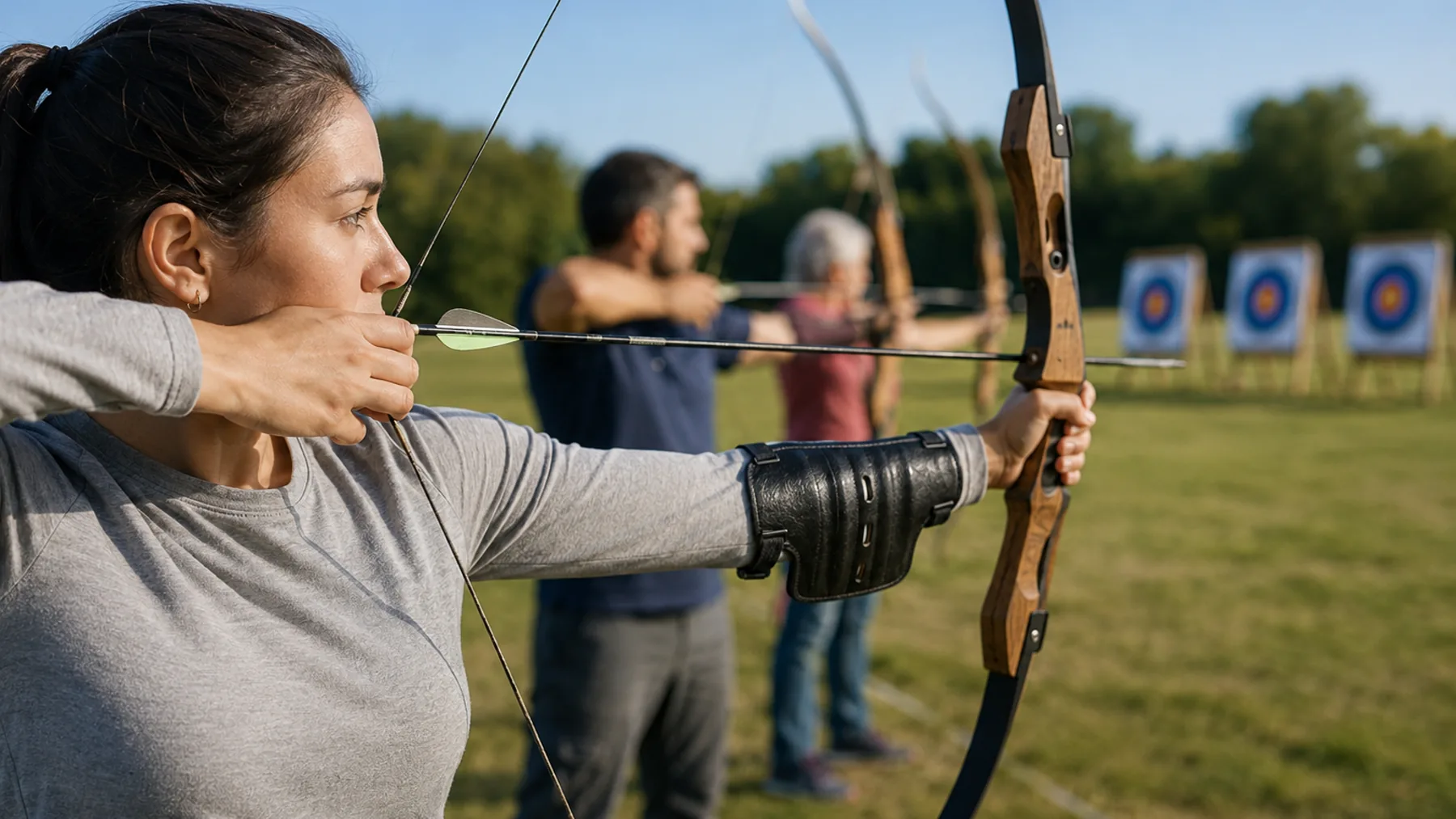
recreational archers in the United States
— Archery Trade Association nationwide survey, conducted by McKinley Advisors, 2020
of recorded archery injuries in men were contusions and abrasions
— Orthopedic Reviews, vol. 15, epidemiological study of archery-related injuries, 2023
average of the 41 written buyer reviews: 32 five-star, 5 four-star, 4 three-star
— Fletchguard verified buyer reviews, 2026
The 2023 study in Orthopedic Reviews names forearm braces among the safety equipment archers should use. It does not break its injury figures down by body part, so we make no forearm-specific claim from it.
Arm guard, sleeve, or nothing at all
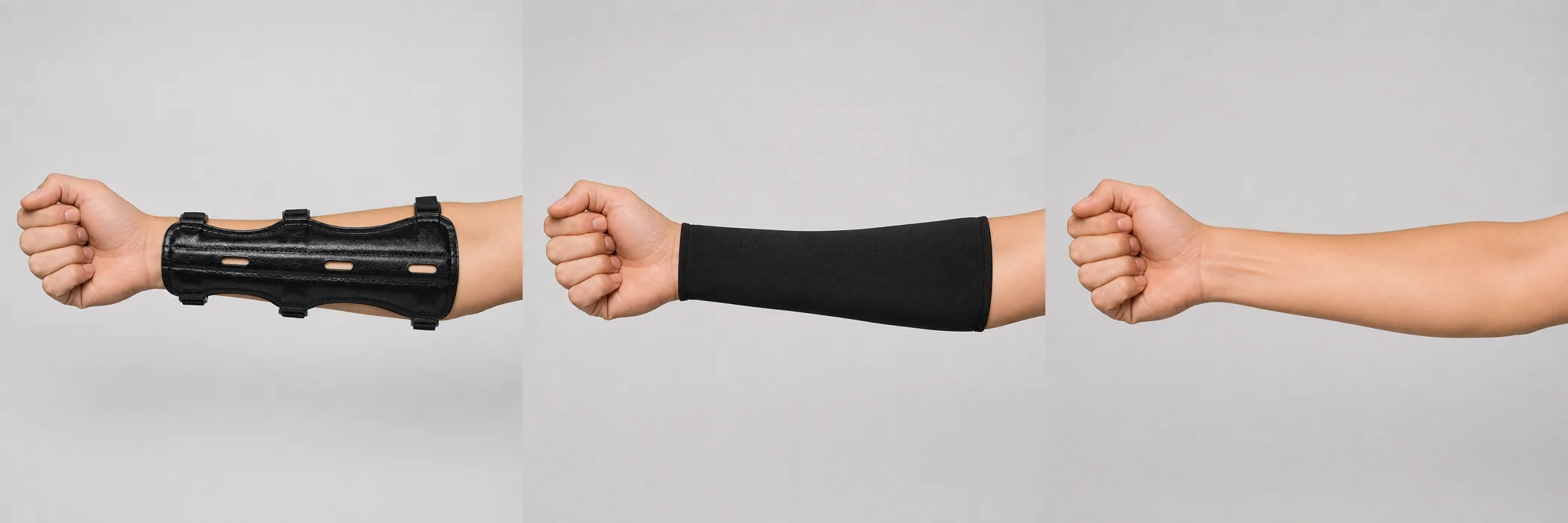
| Rigid 3-strap guard | Elastic sleeve | Nothing | |
|---|---|---|---|
| Spreads the impact | Yes, across a stiff plate | Partly, fabric only | No |
| Flattens a bulky sleeve | Yes, three straps compress it | Some | No |
| Stays where you put it | Yes, thanks to the center strap | Tends to roll down | Not applicable |
| Breathes in summer | Yes, vented slots | Depends on the fabric | Yes |
| Packs flat in a quiver pocket | Yes | Yes | Not applicable |
| Typical price | $8 to $25 | $7 to $18 | Free until it is not |
Sleeves are comfortable and genuinely popular with target archers who have clean form and thin summer clothing. They are the weaker choice for anyone still building form, for cold-weather shooting, and for field archery where you are pushing through brush. A rigid plate is the one that survives contact with a heavy jacket. Given that the 2023 Orthopedic Reviews study names forearm braces specifically in its prevention recommendations, a rigid guard is the safer default for a beginner.
The guard goes on before the bow comes out of the case. Not because I expect a beginner to hit their arm, but because the one who does hit it spends the next month shooting scared, and I would rather never have that conversation.— Corinne Vasek, club archery coach, shooting and coaching since 2009
Everything else worth knowing
Will it fit? Measure before you order
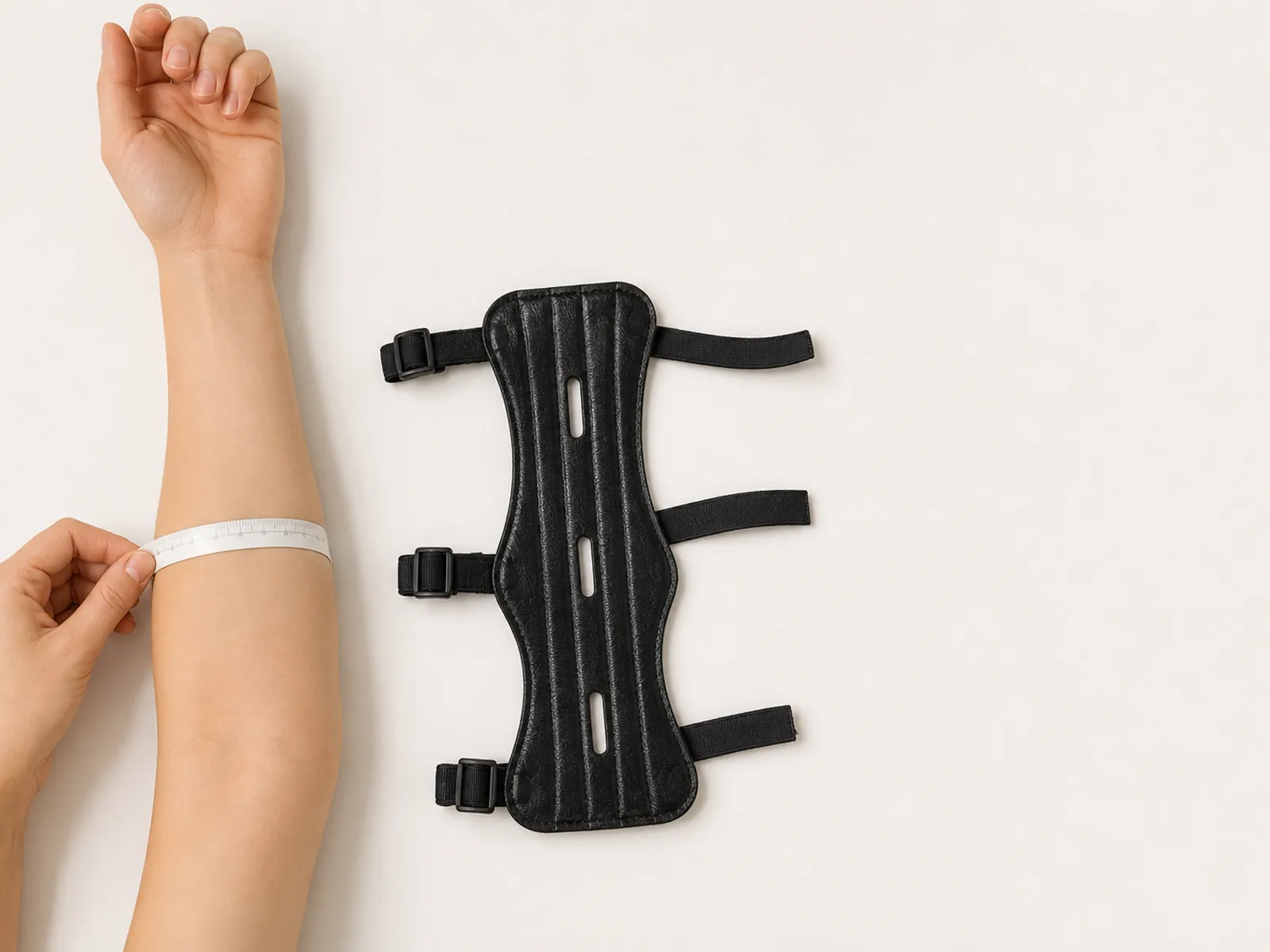
This is the one question worth two minutes of your time, because it is the only recurring complaint in the reviews. The guard is a single size with three independently adjustable elastic straps. That covers the large majority of adult forearms, and one Australian club bought ten of them for shared use, which only works when a guard fits a spread of members. But two buyers out of 41 found it smaller than they had pictured, and neither had measured first.
How to check in two minutes. Take a tape measure or a length of string. Measure the circumference of your forearm at its widest point, usually about a third of the way down from the elbow. Then measure again just below the elbow crease. Write both numbers down.
If both readings sit comfortably below about 13 inches, the straps have room to work and the plate will cover the string line. If either reading is above about 13 inches, write to us before ordering: we will tell you in a minute whether the straps have the travel your forearm needs. That is the one measurement worth taking, and it takes less time than reading this page.
Where it sits and in what order. On the bow arm, inner forearm, wide end toward the elbow and narrow end toward the wrist. Set the middle strap first and snug, then the wrist strap, then the elbow strap last and loosest. Doing it in that order is the difference between the three reviews that call the first fitting fiddly and every session after it that goes without comment.
Fitting it over winter clothing
Cold-weather shooting is where experienced archers get caught out. A fleece or a jacket sleeve adds bulk exactly where the string passes, and the string will find it. The guard handles this, but only if you fit it properly.
Put the guard on over the sleeve rather than under it, and tighten the straps until the fabric underneath is compressed flat rather than gathered into folds. A fold under the plate is a ridge, and a ridge is a fresh target for the string. If your jacket is thick enough that the straps run out of adjustment, push the sleeve up and wear the guard against your base layer instead.
Specifications
| Type | Rigid-plate forearm guard, worn on the bow arm |
|---|---|
| Face material | PU leather (synthetic), grained finish |
| Straps | Three elastic straps, each adjustable on its own sliding buckle |
| Ventilation | Three slots through the face of the plate |
| Construction | Perimeter stitched with a bound edge |
| Color | Black, single colorway |
| Sizing | One size, adjustable. See the fit guide above |
| Suits | Recurve, compound, longbow and traditional |
Rated 4.7 out of 5 across 125 verified ratings
The full set is on the reviews page.
"Bought 10 for our archery club. They were as described and shipped quickly. We are happy with them. Amazing for the price."
— Verified buyer
"For beginners, important and good arm protection for archery. Top value for money. 5 stars. With 3 flat fabric rubber straps for tightening."
— Verified buyer
"I liked the construction of the product, it arrived before the expected delivery date."
— Verified buyer
Questions archers actually ask
Is an arm guard necessary for archery?
For anyone still building form, effectively yes: coaches fit one in the first ten minutes, because a single string strike can start a flinch that takes weeks to unlearn. Experienced archers keep wearing one for cold mornings and bulky sleeves, when even a clean release meets fabric. The full chain of causes and fixes is in our string slap guide.
Which arm does an archery arm guard go on?
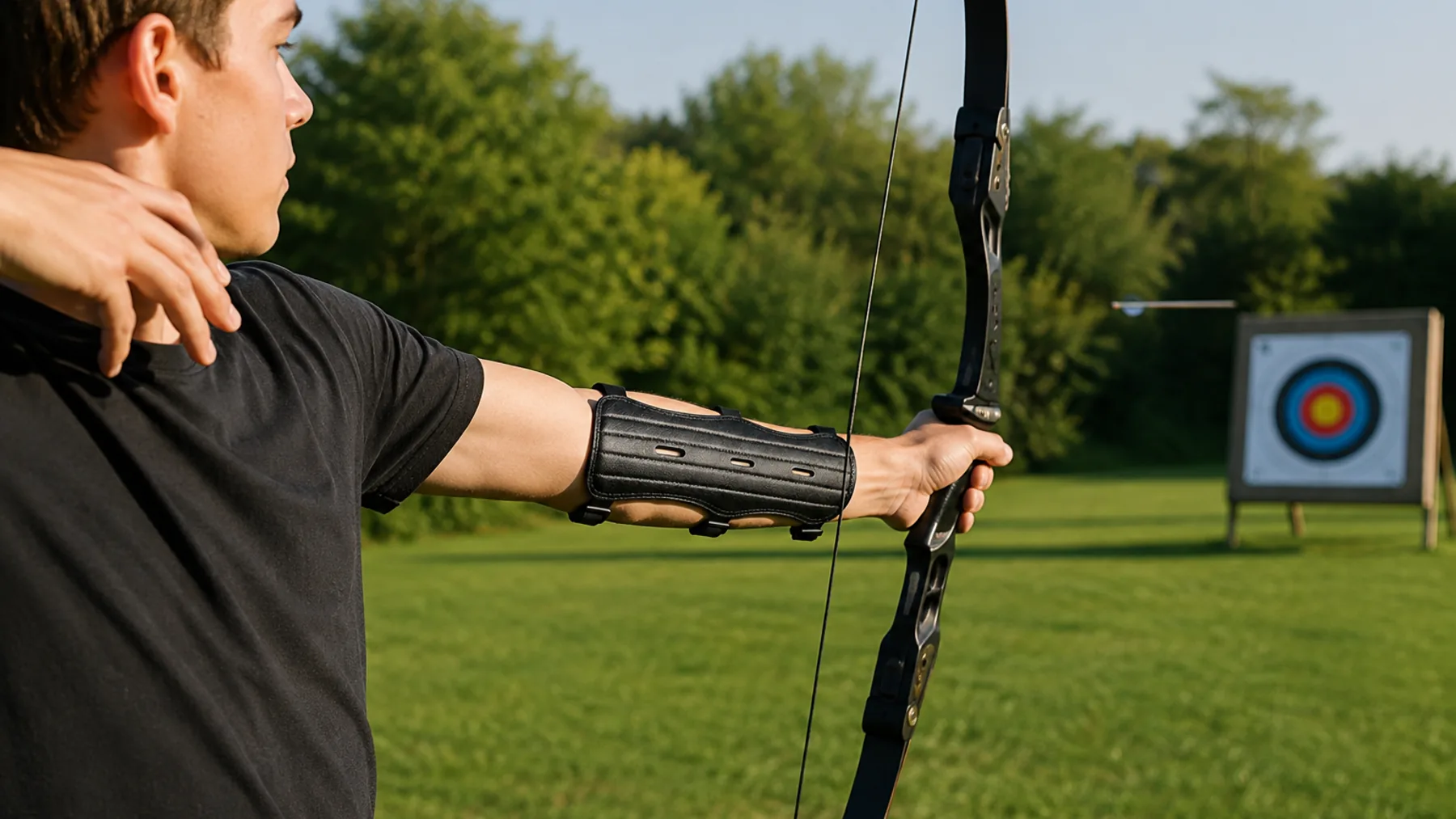
It goes on your bow arm, the one holding the bow, not the drawing arm. If you shoot right-handed you hold the bow in your left hand, so the guard goes on your left forearm. Left-handed archers wear it on the right. The guard sits on the inner forearm, covering the line the string travels on release.
Will this arm guard fit my forearm?
It is a one-size guard with three independently adjustable elastic straps, which covers most adult forearms. Two of the 41 written reviews say it was smaller than they expected, so measure before you order. Wrap a tape around the widest part of your forearm and again just below your elbow. If either reading is above roughly 13 inches, a longer sleeve-style guard will suit you better.
Is this real leather?
No. It is PU leather, also called synthetic leather. It has the grain and the look of leather and it wipes clean more easily, but it is not animal hide and we will not describe it as such. Full-grain hide sells for three to four times this price and needs conditioning; this one wipes clean with a damp cloth.
Does it work for compound bows as well as recurve?
Yes. String slap is a function of your form and your brace height, not your bow type. Compound shooters get caught less often because the string travel is shorter, but a hyperextended elbow will still meet the string. The same guard covers both.
Why do I keep hitting my arm even with decent form?
The usual cause is a locked bow elbow that rotates the soft inner forearm into the string path. Turning your elbow crease outward, toward vertical, moves that flesh out of the way. Loose sleeves and a low brace height both make it worse. The guard buys you the confidence to work on the cause without flinching in the meantime.
Can I wear it over a jacket sleeve?
Yes, and in cold weather you should. Bulky sleeves are one of the main reasons the string catches. Tighten the three straps over the sleeve so the fabric is compressed flat rather than bunched, otherwise you have simply moved the problem outward by half an inch.
How do I clean it?
Wipe the face with a damp cloth and let it dry away from direct heat. Do not machine wash it and do not use solvent cleaners, which will craze the PU surface. The elastic straps can be hand washed if they pick up mud on a field course.
What are the best arm guards for archery?
Judge any arm guard on four criteria: a plate stiff enough to spread a string strike, straps that adjust independently so a tapering forearm stays covered, ventilation that lets you wear it for a full session, and a material that is declared plainly. Our three-strap vented guard is built around exactly those four points: a PU leather plate, three straps on their own sliding buckles, and three vent slots down the face.
How long does delivery take?
Orders are dispatched within 1 to 2 business days and arrive in 6 to 10 business days in total. Shipping is free to all 4 countries we serve, and every order carries a 30-day money-back guarantee.
Stop shooting around the bruise
$19.95, free shipping to 4 countries, 30 days to send it back if it does not fit.
Add to cart →