
Archery chest guards explained
By Corinne Vasek, club archery coach · Updated
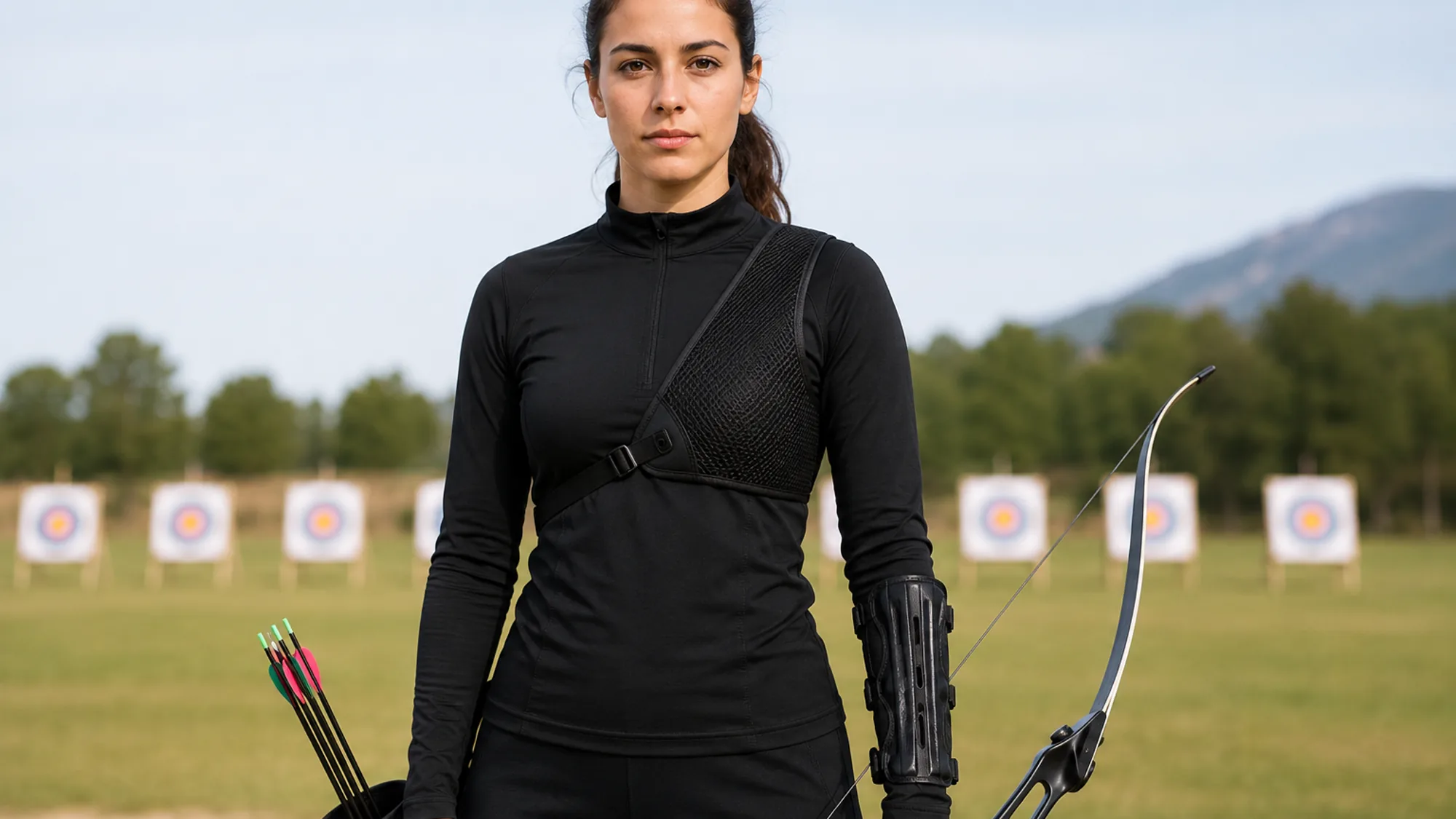
Chest guards are the piece of archery equipment that beginners most often assume is optional and that recurve archers most often turn out to need. They also get confused with arm guards constantly, which is understandable, because both are described as protection and neither really is.
Here is what a chest guard actually does, who needs one, and how to work out whether that is you. Fletchguard does not sell chest guards, so nothing here is trying to move one.
What a chest guard is for
A chest guard is a smooth panel of mesh, leather or synthetic fabric worn across the chest and the front shoulder of the drawing side, held on by a harness of straps across the back.
Its job is not to absorb impact. It is to give the string a clean, flat surface to slide across. At full draw on a recurve, the string sits against or very near the chest, and anything that catches it as it goes forward will deflect the arrow. Loose clothing, a shirt placket, a jacket zip, a chest that simply sits in the string path: all of these disturb the release. A chest guard compresses that area flat and gives the string nothing to snag on.
The consequence of not wearing one when you need one is a shot that goes left for a right-handed archer, sometimes badly, and often inconsistently, which is worse than a consistent error because you cannot aim around it.
How it differs from an arm guard
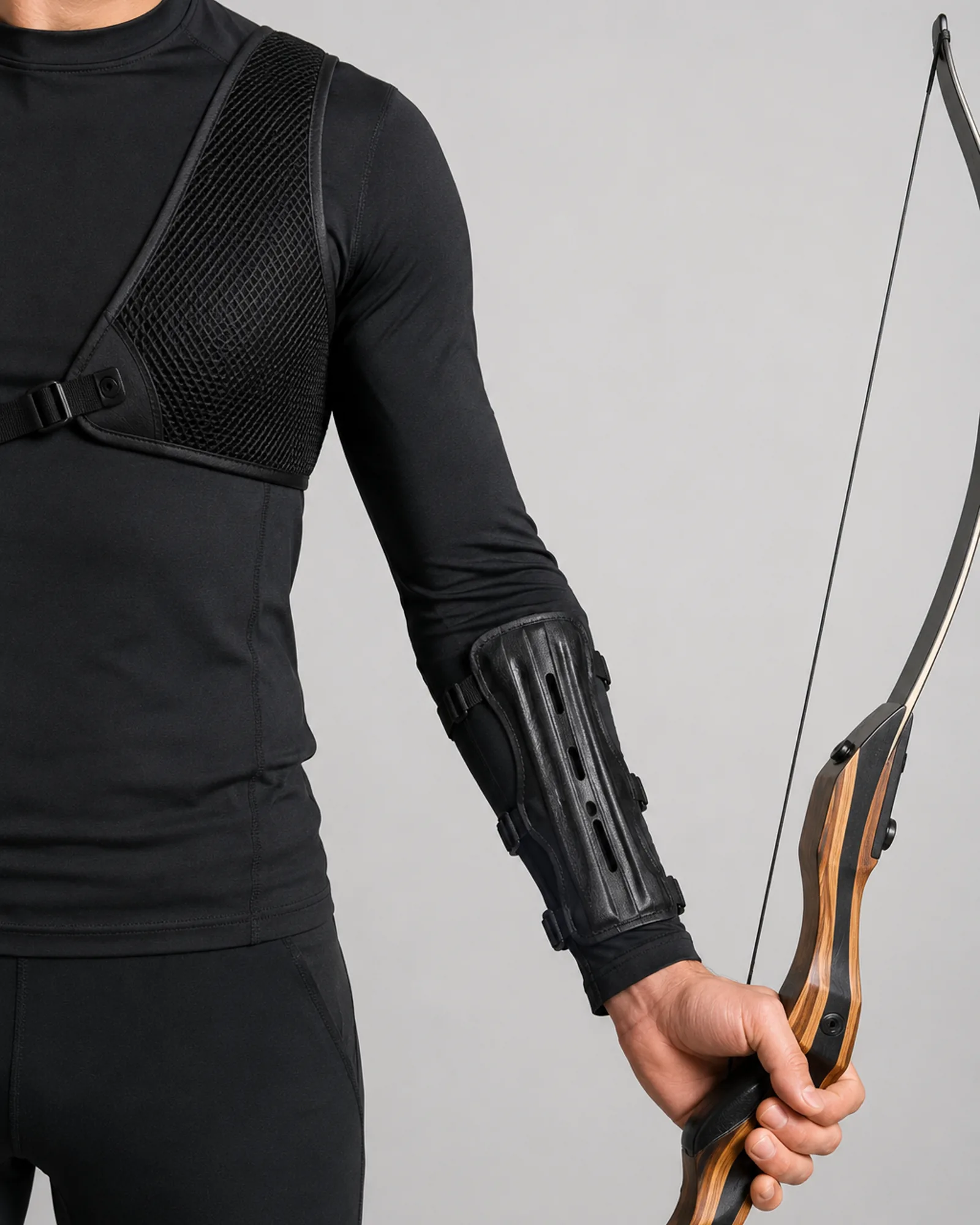
| Arm guard | Chest guard | |
|---|---|---|
| Where | Inner forearm of the bow arm | Chest and front shoulder, drawing side |
| Problem solved | String striking the forearm on release | String catching on clothing or chest at full draw |
| Primary benefit | Stops the bruise and the flinch that follows | Consistent arrow flight |
| Who needs it | Almost every archer at some point | Mostly recurve and traditional archers |
| Typical price | $8 to $25 | $15 to $40 |
The short version is that an arm guard protects you from the bow and a chest guard protects the shot from you. They are not alternatives and owning one says nothing about whether you need the other.
Who actually needs one
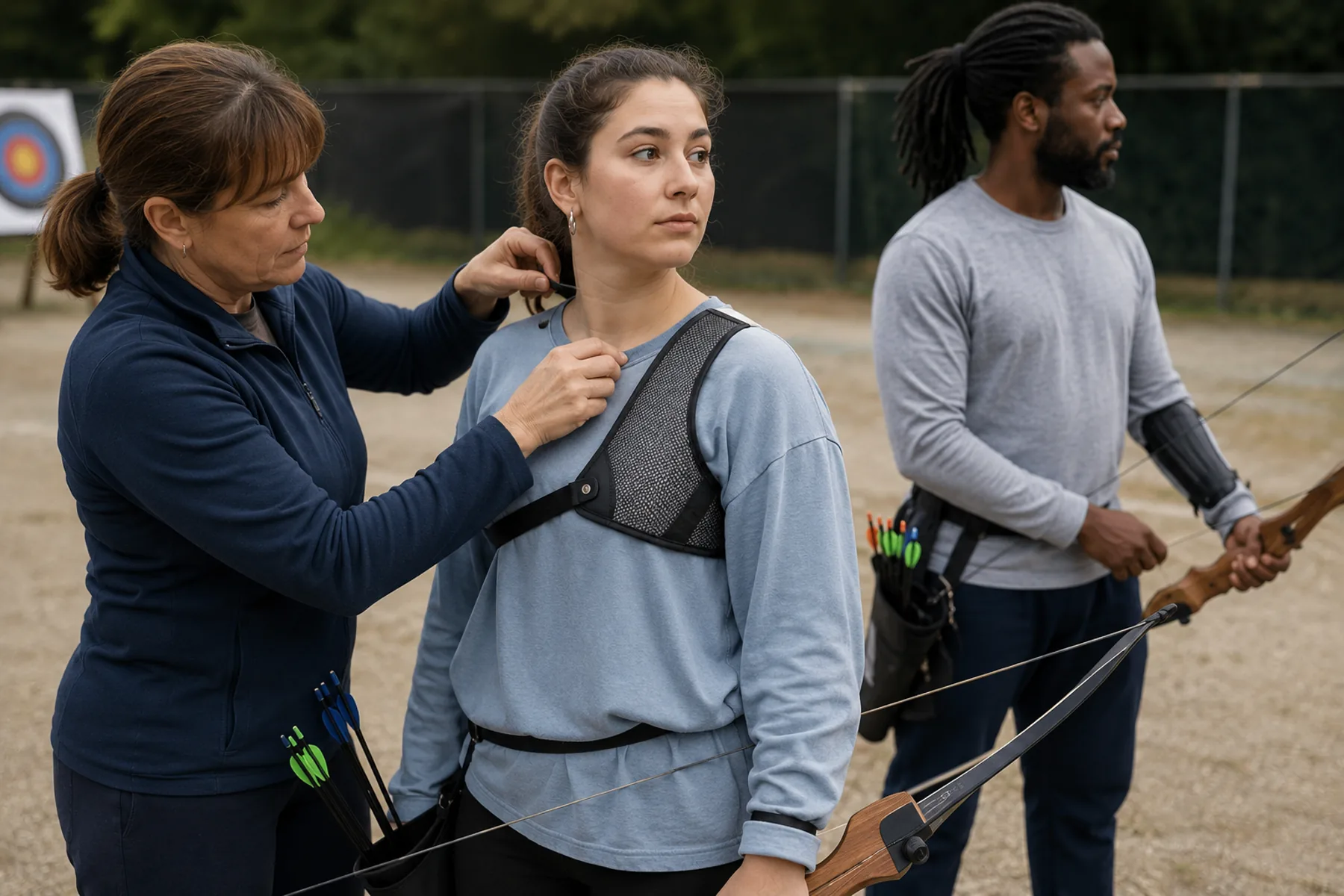
Recurve and traditional archers. Longer draw length and a string that finishes much closer to the body. This is the main group, and at any target competition you will see chest guards on most of the recurve line.
Anyone shooting in loose or layered clothing. Same principle as the arm guard problem. Winter kit creates snag points that summer kit does not, and the shot goes wide without you understanding why.
Women, frequently. This is a practical fact rather than a delicate one. Chest anatomy can sit directly in the string path at full draw, and a chest guard is the standard, universally used solution. It is not a beginner's item and nobody on a shooting line thinks anything of it.
Archers with a long draw for their frame. The further back the string comes, the closer it sits to the chest at full draw.
Compound archers mostly do not need one. The release aid, the shorter draw and the let-off geometry keep the string further from the body. Some field compound shooters wear one for clothing management rather than for the string itself.
Sizing and fitting
Chest guards come in small, medium and large, and the sizing follows chest circumference in the ordinary way. Measure around the fullest part of the chest, under the arms, and use the size chart supplied with the guard you are buying. There is more variation between brands here than there is with arm guards, so use the specific chart rather than assuming.
Fit it so that it lies genuinely flat, with no ridges or folds along the string path, and so that it covers the whole area the string passes. The harness should be snug enough that the panel does not shift when you raise the bow, and no tighter. A chest guard that rides up as you draw is worse than none, because it introduces a moving edge exactly where you wanted a smooth surface.
Mesh versions breathe better and are the norm for summer target shooting. Solid leather or synthetic panels are more durable and are common in field archery, where you are brushing past vegetation.
Do you need both?
Most recurve target archers end up with both, and they buy them for unrelated reasons at different times. The arm guard usually comes first, in the first session, because a coach hands it over. The chest guard tends to arrive later, once someone has noticed a consistent leftward drift and traced it to a shirt.
If you are new and buying one thing, buy the arm guard. String slap is the more immediate problem, it hurts, and the flinch it creates does more damage to your shooting than a snagged shirt does. The reasoning is set out in what causes string slap.
If you already wear an arm guard, shoot recurve, and your arrows drift left without explanation, a chest guard is very likely the missing piece. Try borrowing one from the club box for a session first. The difference, when it is your problem, is obvious within a dozen arrows.
The other kind of protection
Our catalogue is one arm guard: three adjustable straps, vented PU leather, $19.95 with free shipping.
See the arm guard →Related: what causes string slap · guard against sleeve · bow arm guard